

February 23, 2026 · Updated March 7, 2026
Bee and Wasp Nest Removal in Pakistan: When to Call and What Not to Do
Key takeaways
- Safe removal of honey bee hives and wasp or hornet nests from balconies, roofs, trees and wall cavities, with the site treated so they do not rebuild.
- Price: confirmed on site after a free inspection. Typical duration: 1–3 hours.
- Inspection is free and the price is confirmed on the spot before any work.
- Shield Agro, Lahore, serves pest control customers across Pakistan. Call 0321-4583500 or WhatsApp to book a free inspection.
A wasp nest under the water tank or a honeybee colony in the pergola is a real safety risk, especially for children, elderly family members and anyone with an allergy. Every summer we get calls after someone tried a broom or a bucket of water first.
Nest removal is a short job when it is done with the right protective gear, at the right time of day and with the right product. Where it is a honeybee colony we remove it rather than destroy it wherever that is practical.
Why it happens in Pakistani homes and buildings
Wasps build under eaves, in water-tank cavities, inside unused chimneys and in gaps in the boundary wall. Honeybees settle in hollow spaces: pergola posts, roof cavities, old meter boxes and tree trunks. Spring and early summer are the peak for new nests.
Signs you need bee & wasp nest removal
- Repeated wasp or bee traffic to one point on the building
- A visible papery nest or a comb in a cavity
- Buzzing from a wall, chimney or roof space
- Stings around the garden, terrace or water tank
How Shield Agro does bee & wasp nest removal
- Assessment. We confirm whether it is honey bees, wasps or hornets, check access and plan the removal.
- Timing. Removal is scheduled for dusk or early morning when the colony is least active.
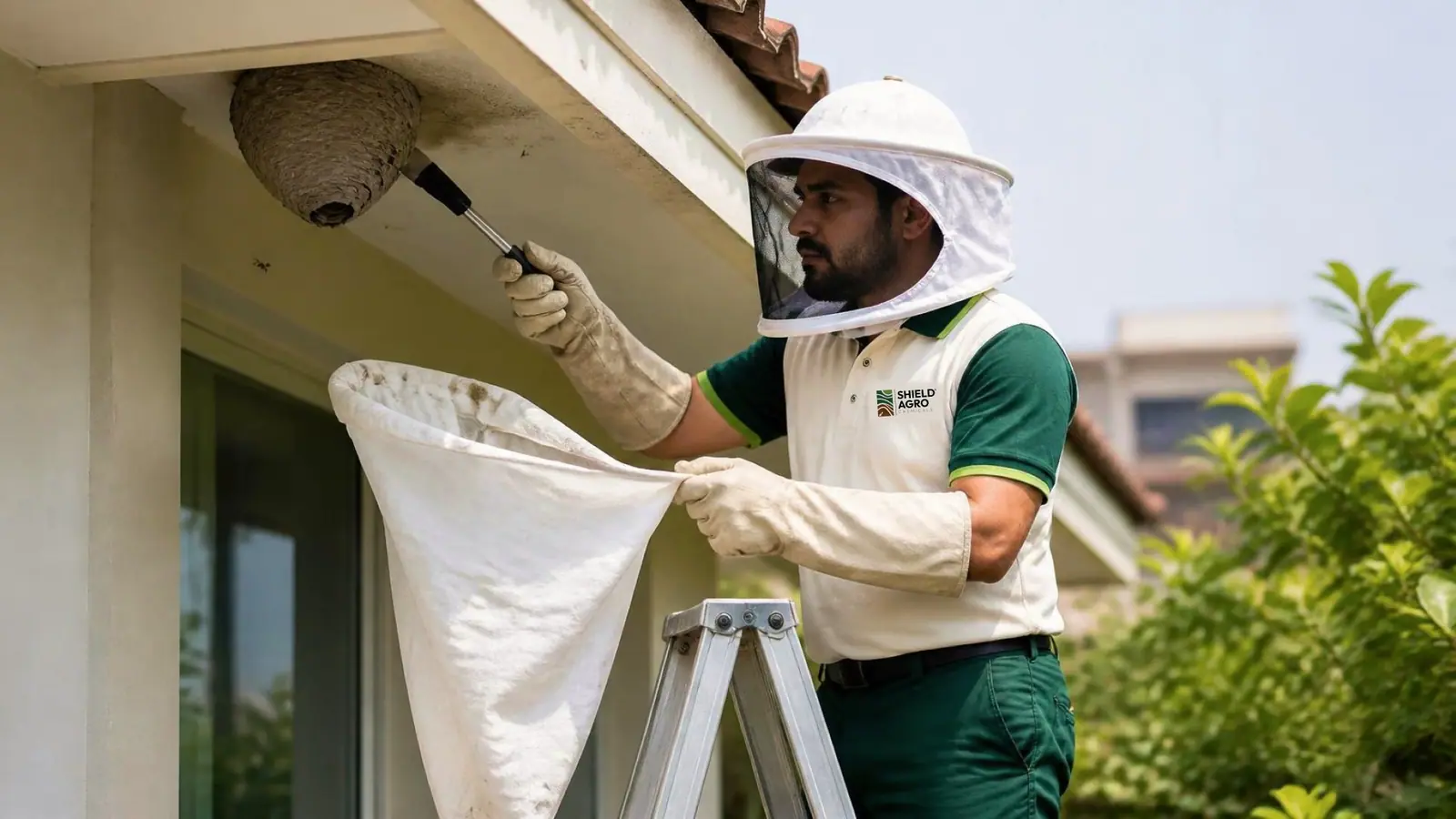
- Removal. Protected technicians remove the hive or nest, relocating honey bees where practical.
- Site treatment. Residual comb and scent are cleaned off and the spot is treated to discourage rebuilding.
What is included
- Species identification
- Full protective equipment and safe access
- Complete removal of hive or nest
- Relocation of honey bee colonies where practical
- Cleaning and treatment of the site
- Advice on sealing cavities and ventilators
What does bee & wasp nest removal cost in Pakistan?
Bee & Wasp Nest Removal is priced on site after a free inspection. Price depends on the nest’s size and location, how high it is, and whether a cavity needs to be opened and sealed. There is no call-out charge, and the price we agree is the price you pay.
How to keep the problem from coming back
- Do not spray, burn or pour water on a nest; it makes the colony defensive
- Keep children and pets indoors until the nest is removed
- Seal the cavity after removal so a new colony does not move in
- Check eaves and the water-tank area in spring, when nests are small
Frequently asked questions
What should we do until you arrive?
Keep everyone, especially children and pets, away from the area. Close nearby windows and do not throw anything at the nest or spray it. If someone is stung and has trouble breathing, treat it as an emergency and seek medical help immediately.
Do you kill the bees?
Honey bees are relocated wherever the hive is accessible and the colony is healthy. Wasps and hornets are not relocated. In every case we are honest about what is possible once we have seen the nest.
What affects the price?
The height and access of the nest, its size, and whether it is inside a wall cavity or roof void that needs opening. A small nest on a balcony ceiling is straightforward; a hive inside a cavity takes longer.
Book bee & wasp nest removal with Shield Agro
We are based in Johar Town, Lahore, and cover pest control across Pakistan, with teams in Lahore, Karachi, Islamabad, Rawalpindi, Faisalabad and Multan and scheduled visits elsewhere. Read the full service page for Bee & Wasp Nest Removal, book a free inspection, call 0321-4583500 or message us on WhatsApp with a photo of the problem and your area. We reply under 30 minutes in working hours.