

August 8, 2026 · Updated October 11, 2026
Termite Treatment for Large Houses with Lawns and Gardens in Lahore

Key takeaways
- Lawns keep the soil damp and fed all year, so large plots in Lahore get termites earlier than compact houses.
- A proper treatment covers the outside perimeter, inside floor junctions, garden woodwork and tree bases, usually in one day.
- Full post-construction treatment for a typical home costs Rs 18,000 to Rs 45,000; large plots sit at the upper end.
- Ask for a written scope that names the whole property. Shield Agro's covers full treatments for five years.
If you own a 1-kanal or 2-kanal house in Lahore with a lawn, a few fruit trees and a boundary wall, you are living on the kind of plot termites like most. That is not a scare line. It is what we see every week on inspections in DHA, Bahria Town, Model Town, Johar Town, Gulberg and Cantt: the bigger the garden, the earlier the deemak shows up inside the house.
This guide explains why that happens, what a proper treatment for a large plot looks like, and what you can do this week to check your own house.
Why big plots get termites first
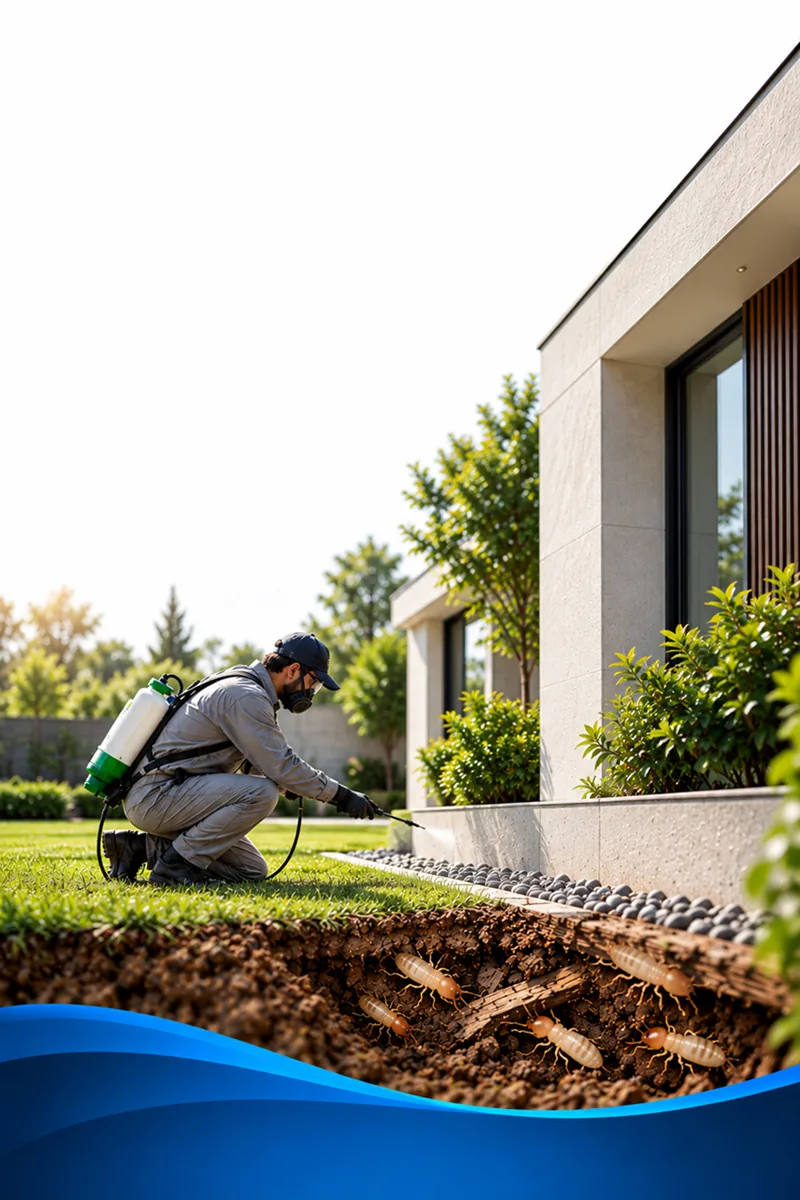
Termites live in the soil, not in your furniture. Furniture is where you finally notice them. A lawn gives a colony everything it needs:
- Moisture. Daily watering keeps the top layer of soil damp all year, even in June.
- Food. Roots, mulch, dead leaves, wooden pergolas, garden benches and the old timber left over from construction.
- Cover. Grass and flower beds hide the mud tubes that would be obvious on bare ground.
From the lawn, workers follow the moisture along the foundation and enter through the smallest gaps: the joint between the floor slab and the wall, around a drain pipe, or up an outside wall behind a creeper. The first thing most owners notice is a door frame that sounds hollow, paint that bubbles near the skirting, or a thin line of dried mud running up a garage wall.
What a proper treatment covers on a large plot
A small house can sometimes be protected by treating the inside floor junctions alone. A house with a lawn cannot. If the barrier stops at the veranda, the colony simply walks around it. On large plots we treat in this order:
- Inspection of the whole plot, not just the rooms with damage. We look at the lawn edges, tree bases, boundary wall, servant quarters, the garage and any outdoor store.
- Outside perimeter barrier. Holes are drilled along the outer foundation at fixed spacing and a non-repellent termiticide is injected under pressure so it spreads through the soil and forms a continuous zone. Non-repellent matters: termites do not detect it, walk through it and carry it back to the nest.
- Inside floor junctions. Every room, at the floor-to-wall joint, plus the bases of door frames and any built-in woodwork.
- Garden woodwork and tree bases. Pergolas, planters and the soil around large trees are treated separately, because that is often where the colony actually lives.
- Sealing and clean-up. Every drill hole is plugged and made good, so a week later you cannot tell where we worked.
The whole job on a 1-kanal house is usually a single day. You do not need to empty rooms or move out.
The aftercare is the part to read carefully
Any company can spray. What separates a treatment from a temporary fix is what happens if termites come back. Every full treatment we do is quoted with a written scope, and on a large plot that scope should name the whole property, not just the house. A follow-up visit after treatment confirms the result.
Ask for the scope and the follow-up date before the work starts, whoever you hire.
Five checks you can do this weekend
- Tap the bottom of every external door frame with a screwdriver handle. A papery, hollow sound means the inside has gone.
- Walk the outside of the house and look for mud tubes on the plinth and behind downpipes.
- Lift a paving slab or brick edge near the lawn. Live termites are pale and move away from light quickly.
- Check the garage, the store and the servant quarter. These are treated as afterthoughts and are usually the first rooms hit.
- After rain, look for small translucent wings on window sills. Swarmers mean an established colony nearby.
If any of these turn up something, send us a photo on WhatsApp. We will tell you honestly whether it looks like termites and whether it needs a visit.

What it costs
For a typical home, full post-construction termite treatment runs between Rs 18,000 and Rs 45,000 depending on covered area and how far the infestation has spread. A large plot with a lawn sits at the upper end because the outside perimeter is longer and garden woodwork is included. We inspect free, measure, and give you one fixed price. There is no call-out charge and no surprise on the day.
Book a free inspection
We are based in Johar Town and cover all of Lahore, and the rest of Punjab, Sindh, KPK and Balochistan on a schedule. Book a free inspection or read more about our termite control services.